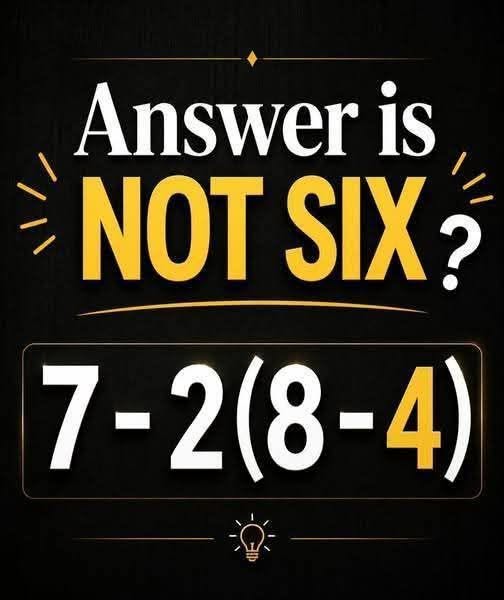
The Viral Math Puzzle That Sparks Endless Debate
Every few months, a simple-looking math problem spreads across social media and sparks heated arguments.
People confidently post different answers. Comment sections explode. Friends debate. Teachers weigh in. Even calculators sometimes appear to disagree.
One recent example is:
7 − 2(8 − 4)
At first glance, it seems like a basic arithmetic exercise. Yet thousands of people end up with different answers because they rush through the calculation or forget a key rule of mathematics.
Why These Math Puzzles Go Viral
Viral math puzzles are designed to trigger quick reactions.
Most people see a familiar equation and immediately try to solve it mentally without carefully reviewing the order of operations.
The result?
Different interpretations, confident answers, and endless online debates.
These puzzles aren't necessarily testing intelligence. More often, they test patience and attention to detail.
The Importance of Order of Operations
To solve equations correctly, mathematicians follow a standard sequence often remembered by the acronym:
PEMDAS
- Parentheses
- Exponents
- Multiplication and Division (from left to right)
- Addition and Subtraction (from left to right)
The key point many people overlook is that multiplication does not automatically come before division, and subtraction does not automatically come after multiplication.
Operations at the same level are performed from left to right.